5.0 Rating on Google Reviews
Female hair loss is far more common than most women realise, and it is rarely “just one thing”. Shedding after a baby, thinning through perimenopause, a widening parting after a stressful year: each has a different cause, so each needs a different plan.
At The Axis Clinic in Crouch End, North London, every hair loss journey starts with the same question: why is this happening? Once the root cause is clear, our doctors can support regrowth with in-clinic regenerative treatments and a realistic at-home routine.
Perimenopause and menopause. As oestrogen and progesterone fall, the hair growth phase can shorten and follicles can become more sensitive to androgens. Many women notice a wider parting, thinning at the crown or temples, and finer strands, often years before periods stop.
Hormonal changes around pregnancy. High oestrogen in pregnancy keeps more hairs in the growth phase. After birth those hairs shed together, usually two to four months postpartum. This often settles on its own, but it can unmask an underlying thinning or be made worse by low iron.
Stress, illness and shock to the system. A stressful event, illness, surgery, crash dieting or a high fever can push many hairs into the resting phase at once. This is called telogen effluvium, and the shedding usually shows up around three months after the trigger.
“Alopecia” simply means hair loss, and there are several types. Some need a formal diagnosis from your doctor or a dermatologist who specialises in hair loss:
Hair is one of the first things the body deprioritises when nutrients run low. The most common culprits are low ferritin (stored iron), vitamin D, vitamin B12 and folate, zinc, and changes in thyroid function.
Many women have more than one of these going on at once. That is exactly why a single product rarely fixes the problem.
Treating hair loss without understanding the cause is like topping up a leaking bucket. If low ferritin or a thyroid issue is driving the shedding, no serum or injection will fully fix it until that is corrected.
Please note: we don’t diagnose medical conditions in clinic. Your consultation is an assessment to understand your hair loss, identify likely contributing factors and decide whether our treatments are suitable for you.
A doctor-led hair loss consultation at The Axis Clinic typically includes:
Once we understand the cause, regenerative treatments can help wake up weakened follicles, extend the growth phase and improve the thickness of each hair. They work best on follicles that are thinning but still active, which is another reason to start early.
PRP scalp injections: the most established regenerative hair treatment. Your platelets are concentrated and injected into thinning areas to release growth factors. A typical course is three to four sessions about a month apart, then maintenance.
PRF (platelet-rich fibrin): spun at a lower speed without anticoagulant, it forms a fibrin matrix that releases growth factors more slowly, over several days.
Exosomes: tiny vesicles that deliver growth-signalling messages to the follicle. Options include plant-based or lab-derived exosome products applied after microneedling or laser, and autologous options derived from your own blood. The science is promising but newer than PRP, and we’ll always be clear about what the evidence shows.
Scalp microneedling: thousands of controlled micro-channels trigger healing, boost circulation and open a pathway for PRP, PRF or exosomes to reach the follicles.
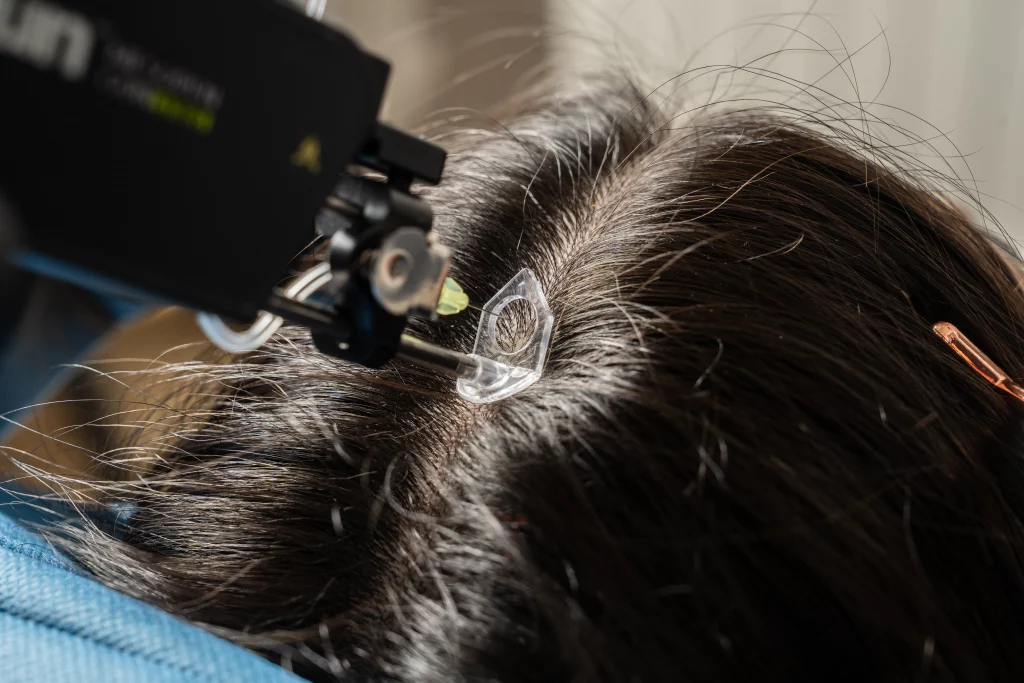
Laser-assisted drug delivery: the LaseMD Ultra creates microscopic channels so growth factors and exosomes are delivered deeper and more evenly, with minimal downtime.
Most women get the best results from a combination plan, alongside correcting any deficiencies. Your doctor will recommend the right mix for your hair loss type.
Our recommended at-home laser cap is the KeraFlex Laser Cap Duo from KeraFactor. It combines two types of light in one cap and is worn in short daily sessions to energise follicle cells and support the growth phase. Like all laser caps, it works best for mild to moderate thinning and only if you use it consistently.
Buy the KeraFlex Laser Cap Duo here (Axis partner link)
Topical minoxidil. Minoxidil is the topical hair loss treatment with the most research behind it. You can buy it over the counter as Regaine (Rogaine in the US) or as other minoxidil products. Expect a temporary increase in shedding in the first few weeks. This is normal and usually settles.
Personalised topicals with the Fagron TrichoTest. In clinic, we offer the Fagron TrichoTest, which looks at genetic factors linked to hair loss. The results help us choose a topical formulation customised to you, rather than a one-size-fits-all product.
Minoxidil-free scalp serums. A cosmetic scalp serum such as Vichy Dercos Densi-Solutions Hair Mass Concentrate is a gentler daily option to support fuller-looking hair.
Hair supplements. Supplements can help fill nutritional gaps, ideally guided by your blood results. Viviscal combines a marine collagen complex with biotin, zinc, iron and vitamin C, and the brand recommends taking it for 3 to 6 months. It isn’t suitable with a fish or shellfish allergy, or if you’re pregnant or breastfeeding.
Scalp-friendly habits.
Hair grows roughly 1 cm a month, and a follicle pushed into its resting phase needs time to re-enter growth. That means you won’t see a real difference in four weeks. Most women see noticeable change in 3 to 6 months, with fuller results building over 9 to 12 months.
Shedding may slow. Minoxidil can cause a temporary increase at first.
Short new “baby hairs” often appear along the parting and hairline.
Improved density and thicker strands, visible in photos.
Take photos in the same light every few weeks to track progress.
The most common reason treatments “don’t work” is stopping too early.
Sometimes treatment alone isn’t enough, or you want to feel confident while you wait for results.
Your consultation is the right place to talk through whether one would suit your type of hair loss.
Not necessarily. Shedding caused by stress, pregnancy or deficiencies is often reversible once the trigger is addressed. Pattern hair loss is ongoing, but treatment can slow it and improve density, especially when started early.
PRP has the longest track record. Exosomes are newer and promising. Many women benefit from combining regenerative treatments with microneedling or laser-assisted delivery. The right choice depends on what’s behind your hair loss.
If you are shedding or thinning, it’s sensible to ask your doctor to check ferritin, vitamin D, B12, folate and thyroid function. Bring your results along to your consultation.
Most in-clinic plans involve three to six sessions spaced a few weeks apart, followed by maintenance.
Postpartum shedding often settles by itself within months. If it doesn’t, ask your doctor to check your iron levels, and a consultation can help work out whether treatment is suitable. Some treatments and supplements aren’t suitable while breastfeeding, so always tell us.
Hair loss is personal, and the right plan starts with understanding your cause. Our doctors look at the whole picture, from hormones and nutrition to lifestyle and scalp health, then build a plan that combines medically led in-clinic treatment with realistic at-home care.
The Axis Clinic · 32 Broadway Parade, Crouch End, London N8 9DB · 020 8350 3421 · info@axisclinic.co.uk
This article is for general information and isn’t a substitute for personalised medical advice. Results vary between individuals.
Live Chat

Be the first to hear about our latest treatments, expert insights and clinic news, straight to your inbox.
By entering your email, you agree to our Terms of Service and Privacy Policy, including receipt of emails and promotions. You can unsubscribe at any time.